Clay Terminology Guide
/
Here’s list of terms you may hear around the studio! Have further questions? Ask on Clay Q&A, your instructor, or a staff person!
Absorbency: The ability of a clay body to absorb water, impacting the drying and firing processes.
Alumina: A ceramic material that has a high melting point. We add it to our pink wax for lidded vessels, which helps the lids separate after firing process.
Atmospheric Firing: Atmospheric firing is a ceramics technique where the chemical composition of the kiln atmosphere (vaporized minerals, fuel particles, or oxygen levels) is altered during firing to directly interact with and glaze the pottery. Examples of atmospheric firing include gas/ reduction firing, wood firing, soda firing, pit firing, and raku.
Bat: A flat disc made from masonite or plastic that attaches to a wheel for throwing.
Bat Pins: Pins used to secure a bat to the potter's wheel, ensuring stability during throwing. All of our wheels have bat pins in place.
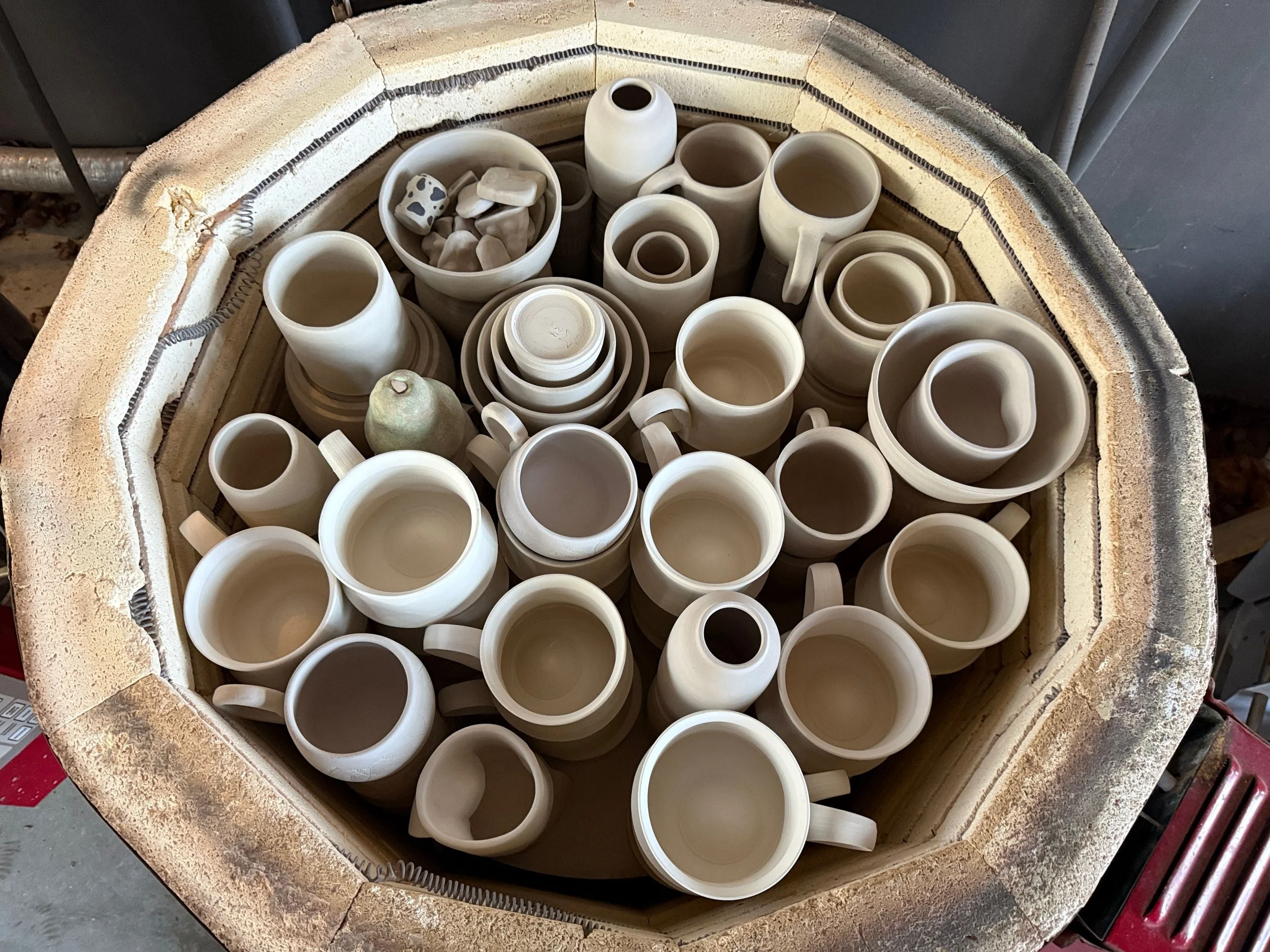
Bisque Firing: Bisque firing is the crucial first, low-temperature kiln firing of dried clay (greenware), typically reaching 1650ºF-1940ºF(Cone 06–04). It transforms fragile clay into durable, porous "bisqueware" that is easy to handle and ideal for absorbing moisture from glazes while ensuring the piece remains stable for the final glaze firing. RCC bisque fires to cone 06.
Bisqueware: Pottery that has been fired once but not yet glazed.
Bisque Mold: A form used to support clay in a specific shape during slab construction.
Bone Dry: The condition of clay that is completely dry and ready for bisque firing.
Burnishing: Polishing the surface of leatherhard clay to compact it and produce a smooth, shiny surface.
Candling: A slow, low-temperature pre-heat during a kiln firing that ensures even drying.
Ceramics: Objects made from ceramic materials that are subject to a firing process. This could be pottery or space shuttle tiles.
Chamois (pronounced shammy): A type of soft leather used to smooth and compress the rims of wheel-thrown pottery
Chuck: A clay cylinder that has been bisque fired, shaped like an hourglass, used to hold pots upside down for trimming on a wheel. These are helpful with bottles or narrow rimmed forms.
Clay: A naturally occurring inorganic material made up of "plate-like" particles. It is used to make ceramics. The chemical formula is Al2O3⋅2SiO2⋅2H2Ocap
Clay Body: A mixture or formula of types of clay, minerals, and other additives that is used for pottery. At RCC/RCS our clay bodies include Whitestone and Idaho Buff.
Coiling: A hand-building technique in which clay is rolled into long strings or strands and coiled to create the form.
Cone: see Pyrometric Cones.
Contraction: Non-reversible shrinkage of the clay during drying and firing.
Crackle glaze: A decorative glaze that intentionally cracks during cooling to form a cracked pattern.
Crawling: A glaze defect caused by uneven glazing or over-glazing where the glaze retracts from the clay during firing, exposing bare clay.
Crazing: Fine cracks that appear in the glaze of ceramic wares due to tension between the clay and glaze.
Dipping: A glazing technique in which one immerses bisque-fired ceramics into a liquid glaze or slip.
Dunting: Cracking that occurs in ceramic pieces during cooling due to thermal stress. This can happen when the Turquoise glaze is used only on the inside and there is no exterior glaze on the outside of a cylinder.
Earthenware: Is glazed or unglazed nonvitreous pottery that has normally been fired below 1,200 °C (2,190 °F). Basic earthenware, often called terracotta, absorbs liquids such as water. We do not fire these at RCC/RCS.
Firing: The process of heating clay or glaze to specific temperatures in a kiln to achieve a permanent, hard state. There are two firings in our process: the Bisque Firing and the Glaze Firing.
Flameware: A type of clay body that can withstand direct heat on a burner, stove, or oven. This specially formulated clay is used for making cooking pots.
Frit: A common ingredient in glazes. Frit is made by melting, cooling, and grinding glaze into a powder to be used as part of a ceramic glaze formula.
Glaze: A glassy coating made of a variety of materials and colorants that are ground and mixed with water, then applied to pottery to seal and decorate the surface.
Glaze Firing: The second firing, where pieces are fully heated, and the glaze melts into a glassy surface. After the glaze firing, both the clay and glaze are non-porous. At RCC/RCS we glaze fire to cone 6, around 2185˚F.
Glaze Fit: The compatibility of a glaze with a clay body. A poor fit can lead to problems like crazing.
Greenware: Pottery that has not yet been fired.
Grog: Particles that are made of fired clay that have been ground, and then added to a clay body to reduce its shrinkage, add strength, and improve its thermal shock resistance. Clay with grog feels grittier than clay without grog.
Hand-Building: The process of forming pottery using only your hands and simple tools rather than a potter’s wheel.
Kiln: A furnace or thermally insulated oven, built specifically for firing clay and glazes.
Kilnwash: A protective coating applied to kiln shelves to prevent sticking from glazes. Kiln wash is high in alumina and has a very high melting point.
Kintsugi: The Japanese art of repairing broken pottery with lacquer dusted or mixed with powdered gold, silver, or platinum.
Leatherhard: A stage of drying during which clay is still damp enough to be joined or carved but holds its shape. Artists must work quickly during this specific drying stage. The leatherhard stage may be lengthened by using plastic to cover your ceramics and trap the water in the clay.
Lusters: Metallic glazes that give a shiny, iridescent finish to ceramics. These materials have a high toxicity during application and firing. We do not use or fire lusters at RCC/RCS.
Maturing Temperature: The temperature at which a clay body or glaze reaches its optimum level of strength and solidity. Our peak temperature is Cone 6, around 2232ºF.
Oxide: Ceramic oxides are inorganic, non-metallic materials formed by combining oxygen with metallic or metalloid elements (e.g., Al, Zr, Si, Mg). Known for high thermal stability, electrical insulation, high hardness, and chemical inertness, these materials are widely used in structural components, coatings, and electronics.
Oxidation firing: is a ceramics method where an abundance of oxygen is present in the kiln atmosphere, allowing oxygen to react with clay and glaze materials, typically resulting in bright, clean, and consistent colors. It is the default, stable environment for electric kilns and ensures complete fuel combustion.
Paper Clay: Clay mixed with organic fibers to enhance strength and reduce shrinkage.
Pinching: A hand-building technique involving squeezing the clay between the fingers and thumb.
Pinholes: Small holes in the fired glaze surface caused by escaping gases during firing, often due to thick glaze application. These are not ideal for functional surfaces.
Plasticity: The quality of clay that allows it to be shaped and to retain its shape. When clay is plastic, it can bend without cracking.
Porcelain: A white clay body that is known for brilliant white color, smoothness, and translucence.
Porosity: The measure of the empty spaces in a material, which affects the clay's absorbency.
Potter's Wheel: A machine used in the shaping (throwing) of round ceramics.
Pottery: General term for pots and other articles made from fired clay.
Production Pottery: Pottery items produced in large quantities.
Pug Mill: A machine used to mix and recycle clay.
Pyrometer: A digital device used to measure changes in temperatures within a kiln.
Pyrometric Cones: Specially formulated ceramic material (shaped like small triangles) used to visually indicate the temperature inside of a kiln. The cones measure heat + time, and melt at specific temperatures, showing when the ceramics in the kiln have been exposed to the right amount of heat and time. At RCC/RCS we fire to cone 6 (not the same as 06!).
Raku: A Japanese pottery firing process that involves removing the piece from the kiln while hot, and allowing it to cool in the open air or in combustible materials. We occasionally do raku firing workshops at RCS.
Reduction Firing: Reduction firing is a ceramics technique that restricts oxygen in a kiln (typically gas or wood-fired) during the firing process, forcing the atmosphere to become starved of Oxygen or O2. This causes the flame to pull oxygen molecules directly from the clay and glaze, changing metal oxides (like iron or copper) and creating distinct, rich colors, such as reduction reds, celadons, or deep browns.
Rib Tool: A flat, handtool with varying flexibility, (often shaped like a kidney or triangle) used to shape, smooth, or scrape clay. These can be rubber, wooden, or metal tools.
Sgraffito: A technique of applying layers of color to leatherhard pottery and then scratching off parts to create contrasting patterns.
Shrinkage: The reduction in size of a clay body due to water loss during drying and firing.
Slab: A flat piece of clay that is rolled out and used in hand-building techniques.
Slab Roller: A mechanical device used to roll out uniform slabs of clay.
Slip: Liquid clay used in decoration or as a bonding agent between pieces of clay.
Slip Casting: A technique for forming pottery by pouring slip into a plaster mold.
Slurry: A thick, creamy mixture of clay and water used in joining clay pieces and for surface decoration.
Soda Firing: An atmospheric firing method where soda ash or sodium carbonate is introduced into the kiln as it reaches peak temperature. We regularly do soda firing workshops at RCS.
Stain: Colored oxides and other compounds used to color clay bodies and glazes.
Stoneware: A type of clay body fired to a high temperature that is very strong and dense.
Tensile Strength: The resistance of a material to breaking under tension.
Thermal Shock: The stress a material undergoes when it experiences sudden changes in temperature.
Throwing: The process of shaping pottery on a potter's wheel.
Underglaze: Colored decoration applied to greenware or bisqued work. Underglazed areas are often later covered in clear glaze, especially in functional work.
Vitrification: The process of firing clay or glaze to the point where it becomes impervious to liquid.
Ware: Finished pottery products.
Wax Resist: A liquid wax that can be applied to the surface of a pot that prevents glaze from adhering, or applied as a method of decorating greenware or bisqueware. Wax burns off in the kiln.
Wedging: A method of kneading clay to remove air bubbles and prepare it for use.
Wood Firing: An atmospheric firing method where the kiln requires constant attention and manual feeding of wood throughout the firing. This firing process creates unique, unpredictable, and natural glaze effects from the ash and flame.